
 0
0
 0
0
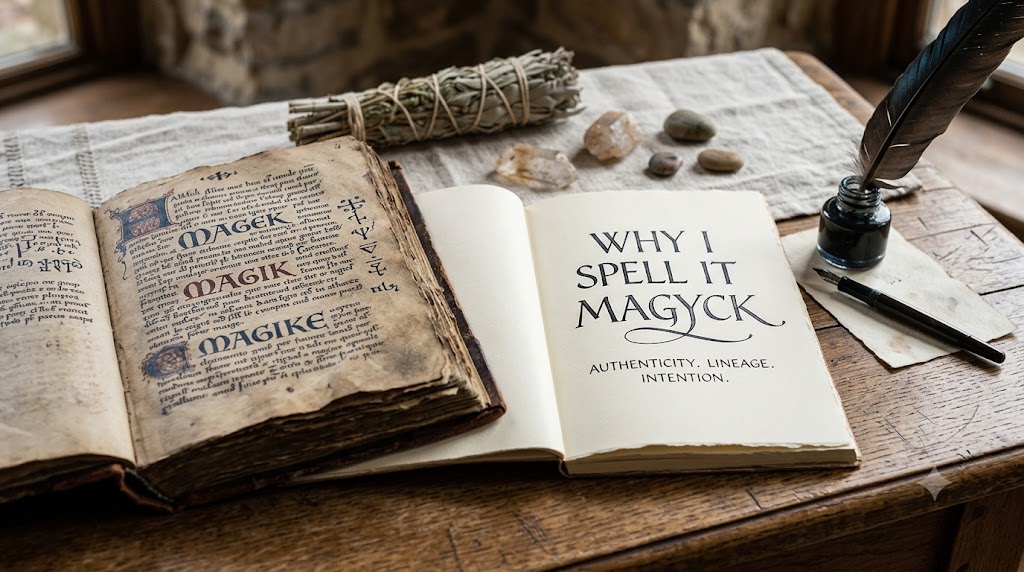
Have you ever noticed the way I spell the word magyck in my articles and titles?
In a world of autocorrect and standardized spelling, adding that “y” and “k” might look like a modern design choice or a simple typo. But in traditional practices, the words we use carry weight.
Language isn’t just a way to get information across; it is a tool of intention. Just as different traditions use different sacred names of God for specific rituals, the way we spell our words connects us to different historical energies.
By choosing magyck over the modern, commercialized spelling of “magic,” I am anchoring my work to history, lineage, and real practice.
Here is the history behind the spelling, and why it matters for your own practice.
1. The Middle English Current: Magike and Magek
If you travel back to the 13th and 14th centuries, you enter the era of the earliest European grimoires. This was a time when the English language was blending with Old French, creating what we now call Middle English.
During this period, there was no single, standardized dictionary. Scribes wrote phonetically, spelling words based on how they vibrated when spoken aloud.
- The History: In medieval manuscripts, you won’t find the word “magic.” Instead, scribes spelled it magike, gmagique, or magek. You can see these linguistic patterns in influential texts from the era, such as the Sworn Book of Honorius (Liber Juratus Honorii).
- The Intent: Today, practitioners of medieval witchcraft, European folklore, and early sorcery use these spelling variations to honor pre-Renaissance traditions. It connects their work directly to the era of handwritten grimoires, before the scientific revolution tried to strip the mystery out of the natural world.
2. The Classical Roots: Magica and Mageia
For those who practice ancient Mediterranean paths—like Hellenistic, Roman, or Egyptian ritual arts—modern English spellings are often bypassed entirely. Instead, practitioners go straight to the ancient languages.
- The History: The Latin term is magica (the feminine form of magicus). This comes from the Ancient Greek word mageia ($\mu\alpha\gamma\epsilon\iota\alpha$). Originally, the Greeks used this word to describe the highly organized spiritual and astronomical practices of the Persian magi (priests).
- The Intent: This root is highly favored by ceremonial magicians, reconstructionist Pagans, and those who work with foundational historical texts like the Greek Magical Papyri (PGM). It carries a vibration of temple ceremony, precise geometry, and cosmic order.
3. The Native English Root: Wiccecræft
It is worth noting that the root word “magic” is actually a foreign import to the English language. Before the Norman Conquest of 1066, the Anglo-Saxons (who spoke Old English) didn’t have the word “magic” at all.
If you want a truly native English term used by historical practitioners of the land, the word is wiccecræft.
- The History: This is the literal ancestor of our modern word “witchcraft.” It is made of two parts: wicce (meaning to bend, turn, or awaken) and cræft (meaning power, skill, or physical strength). To explore how these early terms evolved over time, you can look into the history of Old English linguistics.
- The Intent: Literally translated, wiccecræft means “the power of the shaper” or “the art of the bender.” It is a heavy, earthy term favored by animists, folk herbalists, and those who work closely with land spirits and local ecology rather than ceremonial temples.
The Power of Conscious Language
So, why do I use magyck?
In the 20th century, the occultist Aleister Crowley added the “k” to “magic” to separate high spiritual practice from parlor tricks and stage illusion.
By taking it a step further and using the medieval “y” alongside the “k”, we create a bridge between the historical grimoires of the past and the conscious intent of the present.
When you see magyck spelled this way, it creates a brief pause in your mind. It signals to your subconscious that you are stepping out of the mundane world and into a space where words are treated with reverence.
Every word we speak or write directs a small current of energy. When you choose your words with intention, your practice gains leverage.
Which of these historical roots speaks most to your own path? Do you find yourself drawn to the dusty pages of the medieval grimoire, the structure of the ancient temple, or the raw power of the land beneath your feet?


